The same production, with lower power peaks and a cheaper day.
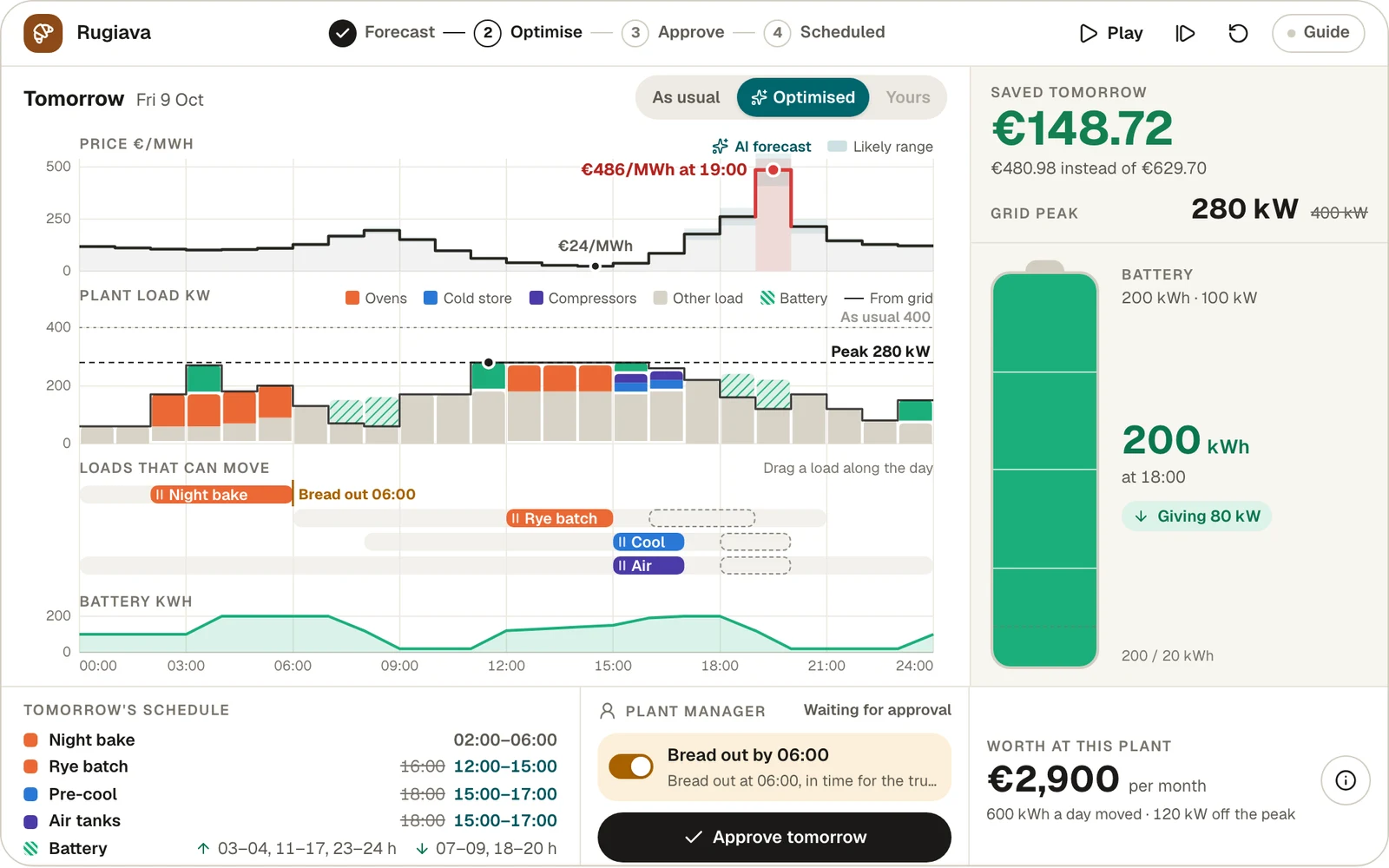
AI energy-peak management forecasts tomorrow's load for each large consumer in your plant from the production plan, past metering and the weather, next to the day-ahead power price.
What changes
- Lower peaksLoads that can wait move out of the peaks, so the plant stays below its power limit and less runs in the dearest hours.
- A cheaper day, measuredEvery schedule shows its cost against a normal day, and the monthly report adds up what was saved.
- Production comes firstOrder deadlines, oven temperatures and air pressure are hard limits: the schedule never trades them for a cheaper hour.
How it works
- 1Forecaststomorrow's load for each large consumer, and the hourly day-ahead price.
- 2Findsthe loads that can move, and the limits they must keep: temperatures, pressures, order deadlines.
- 3Schedulestomorrow's runs, and the battery if you have one, to cut the peak and the cost.
- 4Waitsfor the production lead to approve the schedule; during the day, it warns before a peak.A person decides
Price
- 1. Pilot€7,200
- One site: a forecast for the site and up to 5 large consumers
- Daily schedules compared with what the plant actually did
- Report: the peak and cost reduction available
- Sub-meter plan for the implementation
- 2. Implementationfrom €32,000
- Up to 30 metered loads on one site
- The production plan from MES or ERP, prices and tariff
- Daily schedule for approval, peak alerts, and a battery or storage if present
- Optional PLC signals for approved loads
- Baseline, acceptance test and training
- 3. Licence and support€1,200 /month
- Software licence for one site, in the EU cloud or on your server
- Weekly model retraining, and updates
- Remote monitoring, and 2 hours of support a month
- Monthly energy report with the savings
Fair use: The licence covers one site with one grid connection and up to 30 metered loads. Each extra site is €290 a month.
Works with your systems
- MetersYour main meter's interval data, and sub-meters over Modbus TCP or RTU, M-Bus or pulse outputs.
- PLC / SCADAStates of ovens, compressors and presses over OPC UA or Modbus TCP; setpoints are written only if you enable it.
- PricesNord Pool day-ahead prices for the Lithuanian price area, and your supplier's tariff.
- MES / ERPThe production plan and order deadlines from Rivilė, B1, Business Central or Odoo, or from a file.
- Battery / BMSBatteries and building management systems over Modbus TCP or their API.
- MQTT / APIGateways that publish over MQTT, exports, and the REST API for any other system.
Data security and GDPR
- In the EU, or on your serverThe system runs in our cloud on EU servers, or on a server at your plant. With the on-premises option, metering and production data stay in the plant; only service metrics leave it.
- Your data trains only your modelModels are adapted on your data and used only on your lines. Your images and measurements are not used for other clients' models and are not passed on.
- Kept to compare seasonsMetering, forecasts and schedules are kept for 36 months, so seasons and years can be compared; you can set another period.
- Switching only with your yesBy default the system only advises. Automatic switching works only for the loads you choose, always through your PLC, can be turned off at any time and never overrides a safety function.
- Access by roleProduction and energy leads approve schedules, others see what their role allows, and every approval goes into the activity log.
- GDPR in writingThe system works mostly with product and machine data. Personal data, such as user accounts and who confirmed what, is covered by a data processing agreement that lists every sub-processor.
What you provide
- Access to your main meter's interval data, and your electricity contract and tariff.
- A list of the large consumers, which of them can move, and their limits: temperatures, pressures, deadlines.
- The production plan, from MES or ERP or as a file.
- An electrician to fit sub-meters where needed, following our plan.
- A production or energy lead who approves the daily schedule, for a short training session.
- Purpose
- Forecasts a production site's electrical load and the day-ahead power price, schedules flexible loads and storage to lower peaks and cost within production limits, and warns before a demand limit is passed.
- AI area
- Machine learning: time-series forecasting of load and price, and optimisation of the load schedule.
- Production process
- Production planning: scheduling of energy-intensive process steps (ovens, presses, compressors, chillers) within the production plan.
- Inputs
- 15-minute or hourly metering for the site and its sub-meters; states of ovens, presses and compressors from the PLC; the production plan and deadlines; Nord Pool day-ahead prices; the weather forecast; your tariff and power limit.
- Outputs
- Next-day load forecast for each consumer and the site, with a range; tomorrow's schedule and its cost against a normal day; peak alerts; optional setpoints or on/off signals to the PLC after approval; a monthly energy report.
- Models and approach
- Gradient-boosted decision trees forecast the load, with the production plan, calendar and weather as features, retrained weekly on new data. A mixed-integer optimiser builds the schedule, with temperatures, pressures, deadlines and the power limit as hard constraints. A real-time check compares the 15-minute average with the limit.
- Accuracy validation
- Forecast error (MAPE and peak error) on held-out weeks of your own data; savings measured against a baseline of comparable days before implementation, from your metering, and reported every month.
- Hardware
- None to start with the main meter's data; for each consumer separately, DIN-rail energy meters with Modbus and a gateway; optional PLC outputs or relays for switching.
- Integrations
- Meters over Modbus TCP or RTU, M-Bus or pulse outputs; PLC and SCADA over OPC UA or Modbus TCP; MQTT; Nord Pool prices; MES or ERP (Rivilė, B1, Business Central, Odoo) through APIs or import files; batteries and building management systems; CSV and the REST API; alerts to Microsoft Teams, email or SMS.
- Hosting
- Two options: our cloud on servers in the EU, or on-premises on a server at your plant, with nothing leaving the plant but service metrics. Daily backups kept for 30 days; TLS in transit, encryption at rest.
- Languages
- Interface in Lithuanian and English.
- Limits
- Up to 50 metered loads per site. It plans what your process allows to move and does not change process recipes. Automatic switching only for the loads you approve, and always through your PLC.
- Access
- Sign-in with Microsoft Entra ID or Google, or local accounts for shared screens on the shop floor. Roles: operator, lead (quality, maintenance or production), administrator. Activity log of every confirmation and change.
- Human oversight
- The production lead approves every schedule; automatic switching can be turned off at any time and never overrides a safety function.
- Support
- Business days 8:00–17:00 Vilnius time, remote; critical faults answered within 4 business hours; availability target 99.5% a month for the cloud part.
- Delivered as
- A standard product under licence, configured for your line, with its models adapted to your data. It is not software or an AI model developed to your order.
EU funding · call 02-126-K
The EU can pay half of an AI project for your factory
We prepare the technical part of the application: the case for AI, the specification and the commercial offer. Whether the project is funded is decided by the funding body.
Example: camera quality inspection
An AI project for a factory€38,900pilot, build and hardware
EU funding, 50%€19,450
You pay€19,450
Apply by 8 December16 days left
Frequently asked questions
Didn't find the answer? Ask the AI assistant at the bottom right.
Will the system switch equipment on and off by itself?
Only if you turn that on, and only for loads you have approved – always through your PLC. Normally the production manager approves the schedule and the system warns of an approaching peak.
What if we have no sub-meters?
Data from the main meter is enough to start. We list sub-meters for ovens, presses or compressors in the quote, and an electrician fits them.
How is the saving calculated?
From your metering data, against similar days before the build. The monthly report shows the peaks, the price and the saving.
Can we really get 50% EU funding?
Call 02‑126‑K part-funds AI in the production processes of manufacturing SMEs. We prepare the technical part and the commercial offer; whether the project is funded is decided by the funding body.
Tell us what you need built
A 30-minute video call, then a proposal with a fixed price. Rather not call? Write a message
Book a call
A 30-minute video call. We work out the task and tell you the price range.
November