A bearing failure seen ahead, and the repair planned into a stop you already have.
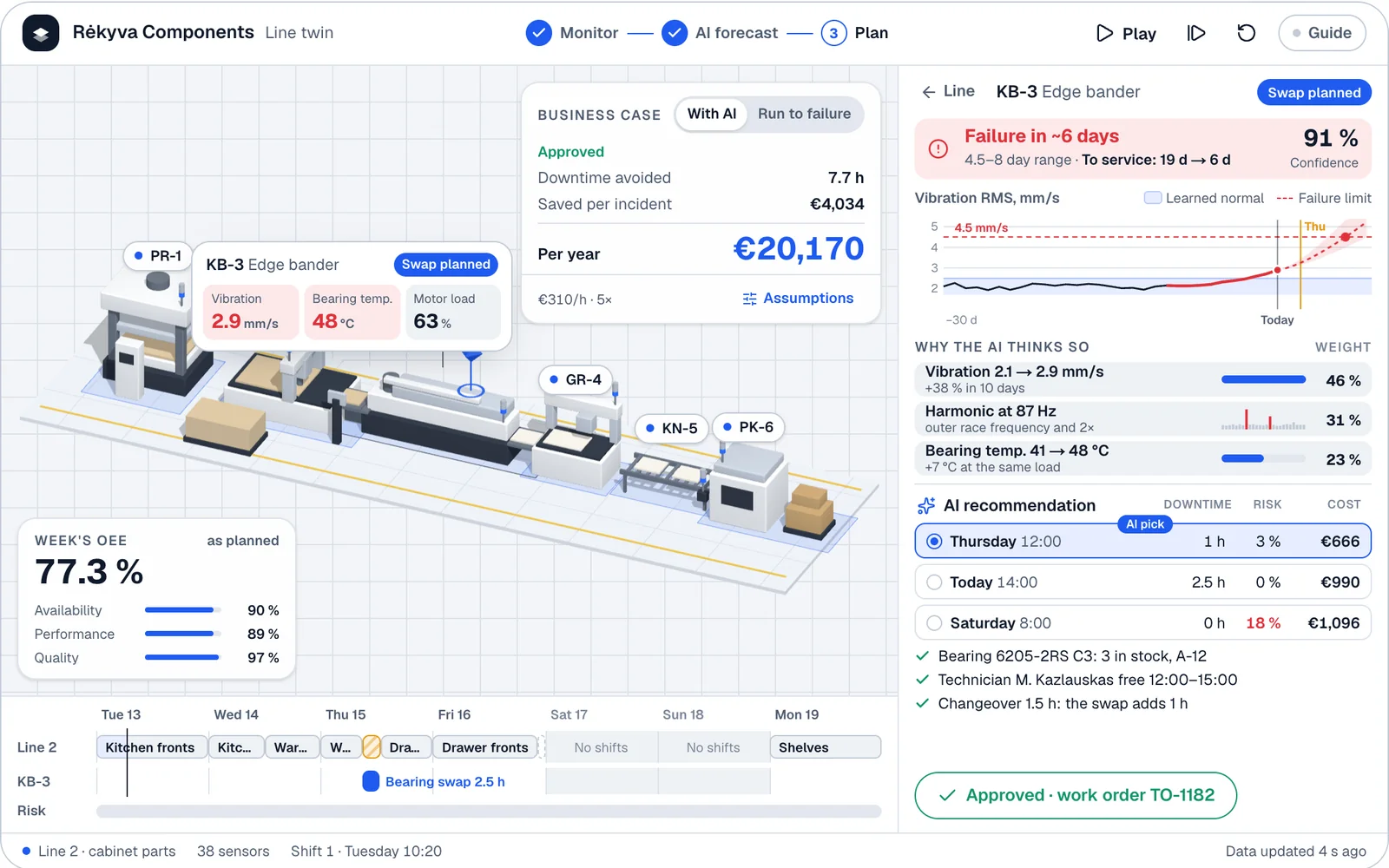
AI predictive maintenance reads vibration, motor current and temperature from your machines, learns how each one runs when it is healthy and spots the change when a bearing, a gearbox or a spindle starts to wear.
What changes
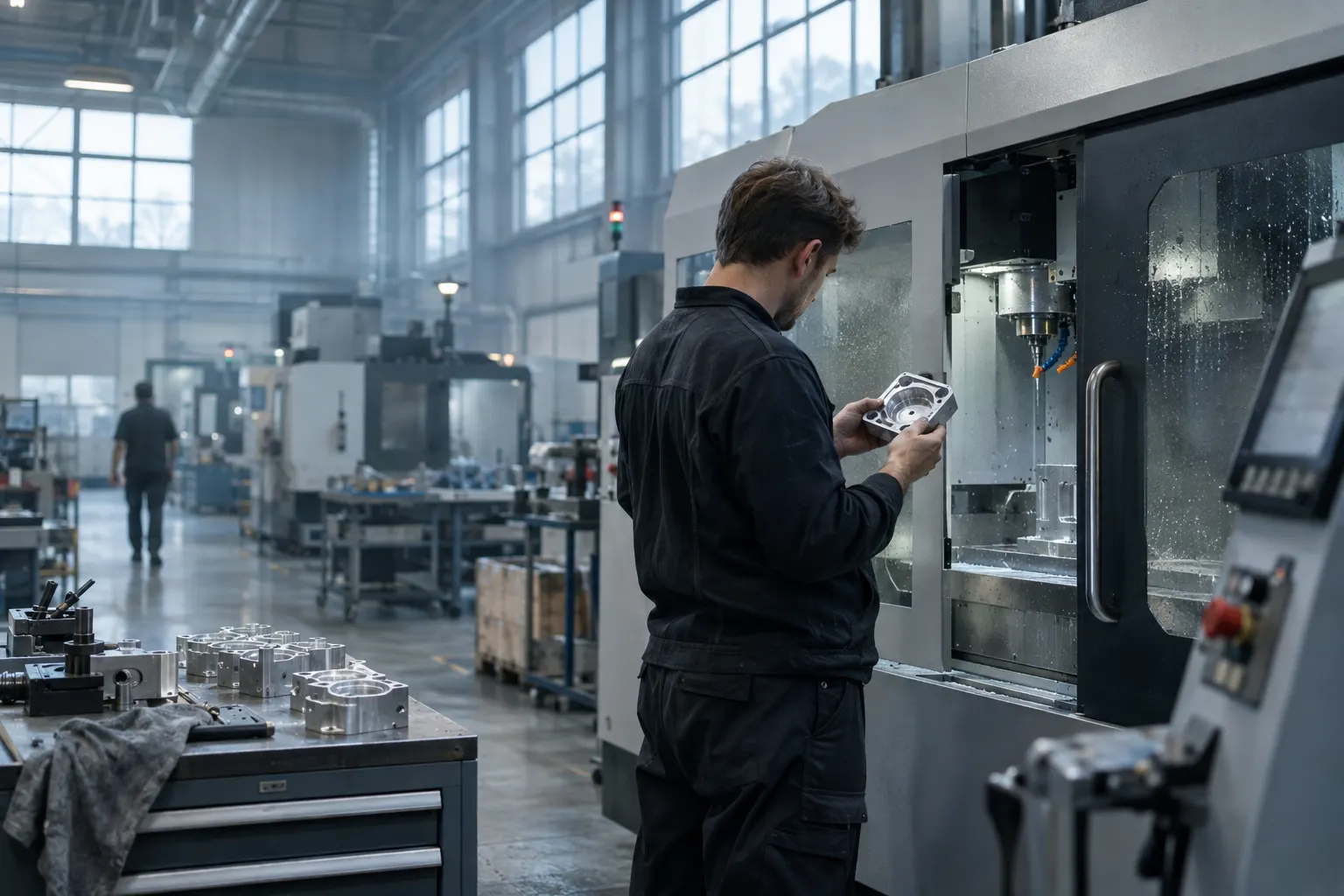
- Fewer unplanned stopsWear shows in the data well before the failure, so the repair happens in a planned stop instead of in the middle of an order.
- Parts ordered in timeThe forecast gives the maintenance team a date range, so the bearing is on the shelf before it is needed.
- Every choice pricedThe digital twin compares repairing now, at the next changeover or running to failure, in hours and euros.
How it works
- 1Measuresvibration, motor current and temperature on each machine, and reads its state from the PLC.
- 2Detectsa departure from the machine's healthy baseline and names the likely cause, such as an outer-race bearing fault.
- 3Forecaststhe remaining useful life with a range, and finds the best slot for the repair in the production plan.
- 4Proposesthe slot to the maintenance lead; once it is approved, the task goes to the maintenance team.A person decides
See it working
Price
- 1. Pilot€9,000
- Up to 5 machines, with sensors fitted by your team
- Healthy baseline and anomaly alerts
- Report: faults found and how far ahead they showed
- Sensor plan for the implementation
- 2. Implementationfrom €45,000
- Up to 20 machines on one site
- Digital twin of the line with the production plan and OEE
- Failure forecasts and maintenance tasks into your maintenance system or ERP
- PLC or SCADA connection over OPC UA, Modbus TCP or S7
- Acceptance test, and training for the maintenance team
- 3. Licence and support€1,500 /month
- Software licence for up to 20 monitored machines, at the line or in the EU cloud
- Model retraining as machines and parts change, and updates
- Remote monitoring, and 2 hours of support a month
- Monthly condition report
Fair use: The licence covers up to 20 monitored machines on one site, with any number of sensors on each. Each extra machine is €25 a month.
Works with your systems
- PLC / SCADAMachine state, speed, load and counters over OPC UA, Modbus TCP or Siemens S7.
- MQTTWireless and wired sensors and gateways that publish over MQTT.
- HistorianPast data from your SCADA historian or a CSV export, for the baseline and past failures.
- MES / ERPThe production plan from, and maintenance tasks to, Rivilė, B1, Business Central or Odoo, through their APIs or import files.
- AlertsMicrosoft Teams, email or SMS when a machine's condition changes.
- CSV / APIExports and the REST API for any other system.
Data security and GDPR
- In the EU, or at your plantThe system runs in our cloud on EU servers, or entirely on a computer at your plant. With the on-premises option, images and machine data stay in the plant; only service metrics leave it.
- Your data trains only your modelModels are adapted on your data and used only on your lines. Your images and measurements are not used for other clients' models and are not passed on.
- Kept as long as it is usefulRaw vibration samples are kept for 90 days. Features, alerts and the maintenance history are kept for the life of the licence, so the models keep learning from them; you can set other periods.
- It never stops a machineThe system reads from the PLC and proposes; a person decides. It writes nothing to the machines, and emergency stops, guards and interlocks stay as they are.
- Access by roleMaintenance staff, maintenance leads and administrators each see and approve what their role allows, and every approval goes into the activity log.
- GDPR in writingThe system works mostly with product and machine data. Personal data, such as user accounts and who confirmed what, is covered by a data processing agreement that lists every sub-processor.
What you provide
- Mounting of the sensors by your maintenance team or an electrician, following our mounting plan.
- Read access to the PLC or SCADA (OPC UA, Modbus TCP or S7), set up by your automation engineer.
- The list of machines in scope, with the motor and bearing data from their documentation.
- Your maintenance history: past failures and repairs, from your system or a spreadsheet.
- The production plan, from MES or ERP or as a file, to plan the repairs around.
- A maintenance lead who approves the slots, for a short training session.
- Purpose
- Monitors the condition of production machines from sensor data, detects faults as they begin, forecasts the remaining useful life of components and plans maintenance around the production schedule, with a digital twin of the line.
- AI area
- Machine learning (anomaly detection, fault classification, remaining-useful-life regression) and a digital twin of the production line.
- Production process
- Main production and its control: the condition of the equipment that runs it, and maintenance planned around the production schedule.
- Inputs
- Vibration from accelerometers (sampled at up to 25.6 kHz for spectra), motor current and temperature; machine state, speed, load and counters from the PLC or SCADA; the maintenance history; the production plan.
- Outputs
- A health score for each machine and component; anomaly alerts with the likely cause; remaining useful life with a confidence range; maintenance tasks with a proposed slot; the digital twin view of the line; OEE; a monthly condition report.
- Fault types
- Rolling-bearing faults (outer race, inner race, rolling elements, cage), imbalance, misalignment and looseness, gear wear, belt faults, motor electrical faults visible in the current, overheating.
- Models and approach
- Signal features: RMS, peak, kurtosis, and FFT and envelope spectra at the bearing and gear fault frequencies. Unsupervised anomaly detection for each machine (isolation forest and autoencoder) on a healthy baseline, usually 2 to 4 weeks of normal running; fault classification from spectral patterns; remaining useful life from the degradation trend, with a confidence range. The digital twin models each machine's state with the production plan and costs each maintenance option.
- Accuracy validation
- Back-tested on your past failures where data exists; in the pilot and the trial run, measured on live data: faults detected, how far ahead of the failure, and false alarms per machine a month. Acceptance thresholds are agreed in writing in the pilot.
- Hardware
- Per machine: vibration and temperature sensors, a current sensor, and a share of a gateway; existing PLC measurements are used where they exist.
- Integrations
- OPC UA, Modbus TCP, Siemens S7 and MQTT; SCADA historians and CSV; MES or ERP (Rivilė, B1, Business Central, Odoo) through APIs or import files; the REST API; alerts to Microsoft Teams, email or SMS.
- Hosting
- Two options: our cloud on servers in the EU, or on-premises on an industrial computer at your line, with nothing leaving the plant but service metrics. Daily backups kept for 30 days; TLS in transit, encryption at rest.
- Languages
- Interface in Lithuanian and English.
- Limits
- Up to 200 machines and 2,000 sensor channels per site. Forecasts need a baseline of normal running, and faults that develop in minutes, such as a sudden tool break, are caught as alarms rather than forecast.
- Access
- Sign-in with Microsoft Entra ID or Google, or local accounts for shared screens on the shop floor. Roles: operator, lead (quality, maintenance or production), administrator. Activity log of every confirmation and change.
- Human oversight
- The AI proposes; the maintenance lead approves every slot and task. It never stops a machine by itself.
- Support
- Business days 8:00–17:00 Vilnius time, remote; critical faults answered within 4 business hours; availability target 99.5% a month for the cloud part.
- Delivered as
- A standard product under licence, configured for your line, with its models adapted to your data. It is not software or an AI model developed to your order.
EU funding · call 02-126-K
The EU can pay half of an AI project for your factory
We prepare the technical part of the application: the case for AI, the specification and the commercial offer. Whether the project is funded is decided by the funding body.
Example: camera quality inspection
An AI project for a factory€38,900pilot, build and hardware
EU funding, 50%€19,450
You pay€19,450
Apply by 8 December16 days left
Frequently asked questions
Didn't find the answer? Ask the AI assistant at the bottom right.
Do we need to change our machines or PLCs?
No. The system only reads data from the PLC or SCADA over OPC UA, Modbus TCP or S7, and your team fits the sensors to our plan. It writes nothing to the machines.
How much data do the forecasts need?
To learn each machine's healthy state, 2–4 weeks of normal-running data is usually enough. If you have a SCADA archive or a failure history, we use that too.
What if the AI gets it wrong?
The maintenance lead approves every repair slot, and we measure the share of false alerts in the trial period and agree the acceptance limits in writing. Sudden faults, such as a tool break, are caught as alarms rather than forecast.
Can we really get 50% EU funding?
Call 02‑126‑K part-funds AI in the production processes of manufacturing SMEs. We prepare the technical part and the commercial offer; whether the project is funded is decided by the funding body.
Tell us what you need built
A 30-minute video call, then a proposal with a fixed price. Rather not call? Write a message
Book a call
A 30-minute video call. We work out the task and tell you the price range.
November