More good parts from every log, board and sheet you buy.
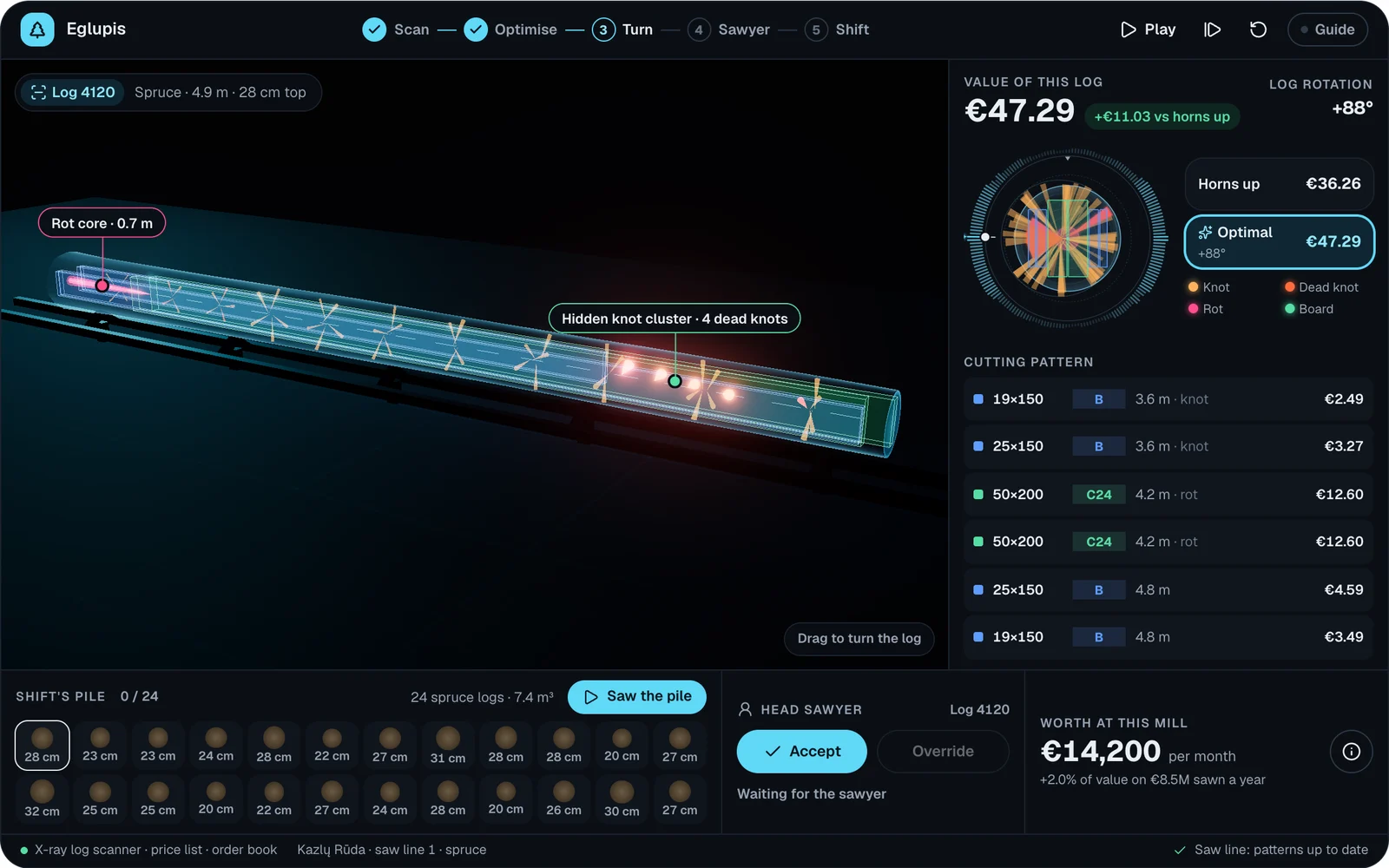
AI yield optimisation takes what you know about the material, from a log scanner, a camera over the boards or plain measurements, together with the orders and your price list, and works out the cutting plan that gives the most value: which sawing pattern, where to cut out a knot, how to nest parts on a panel or a sheet.
What changes
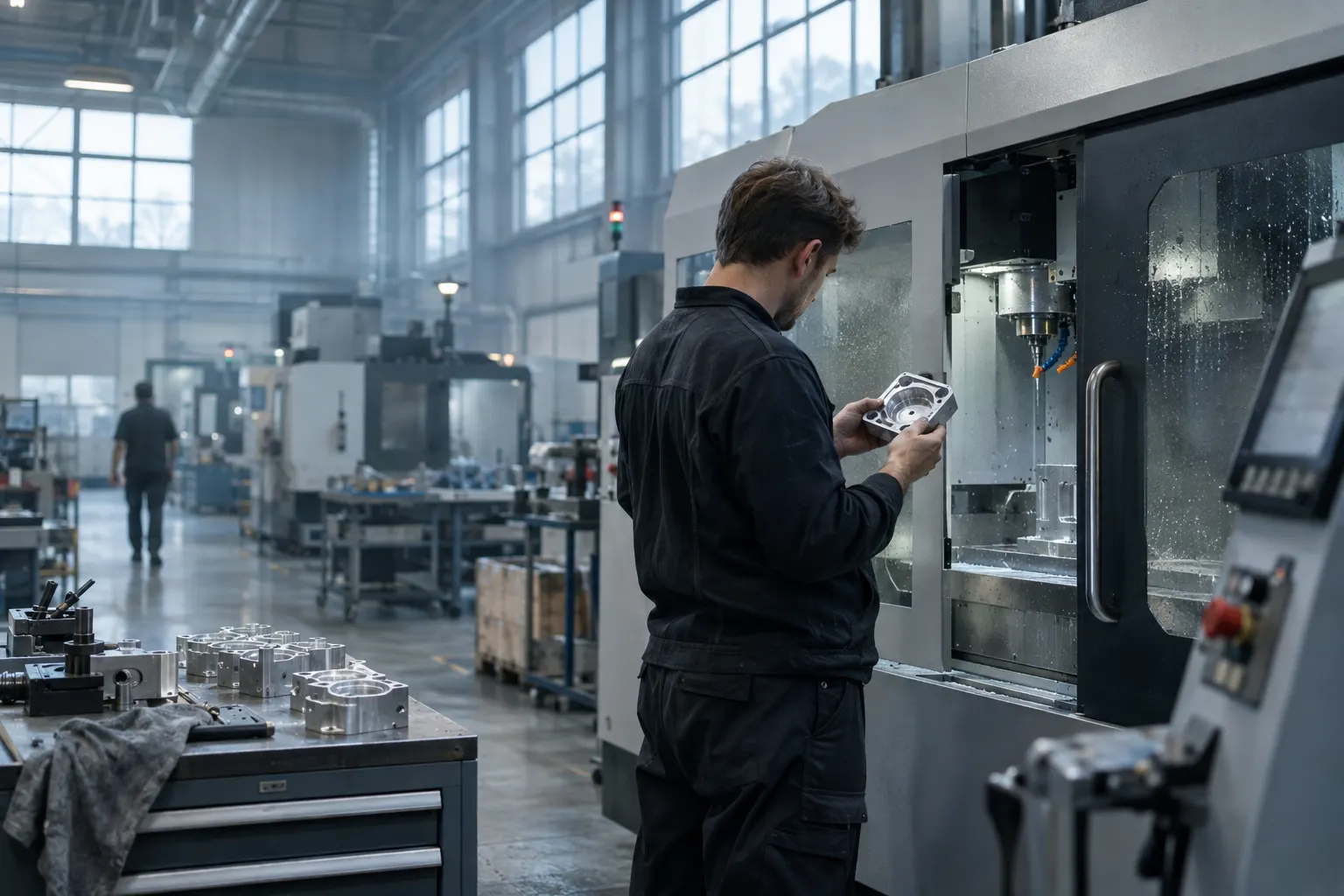
- More value from the same materialEvery log, board or sheet is cut by the plan that gives the most for your orders and prices, not by habit.
- Yield you can seeYield and value by shift, line and material batch, so a drop shows up the same day.
- Offcuts used, not forgottenUsable offcuts go into a register and are nested first in the next plans.
How it works
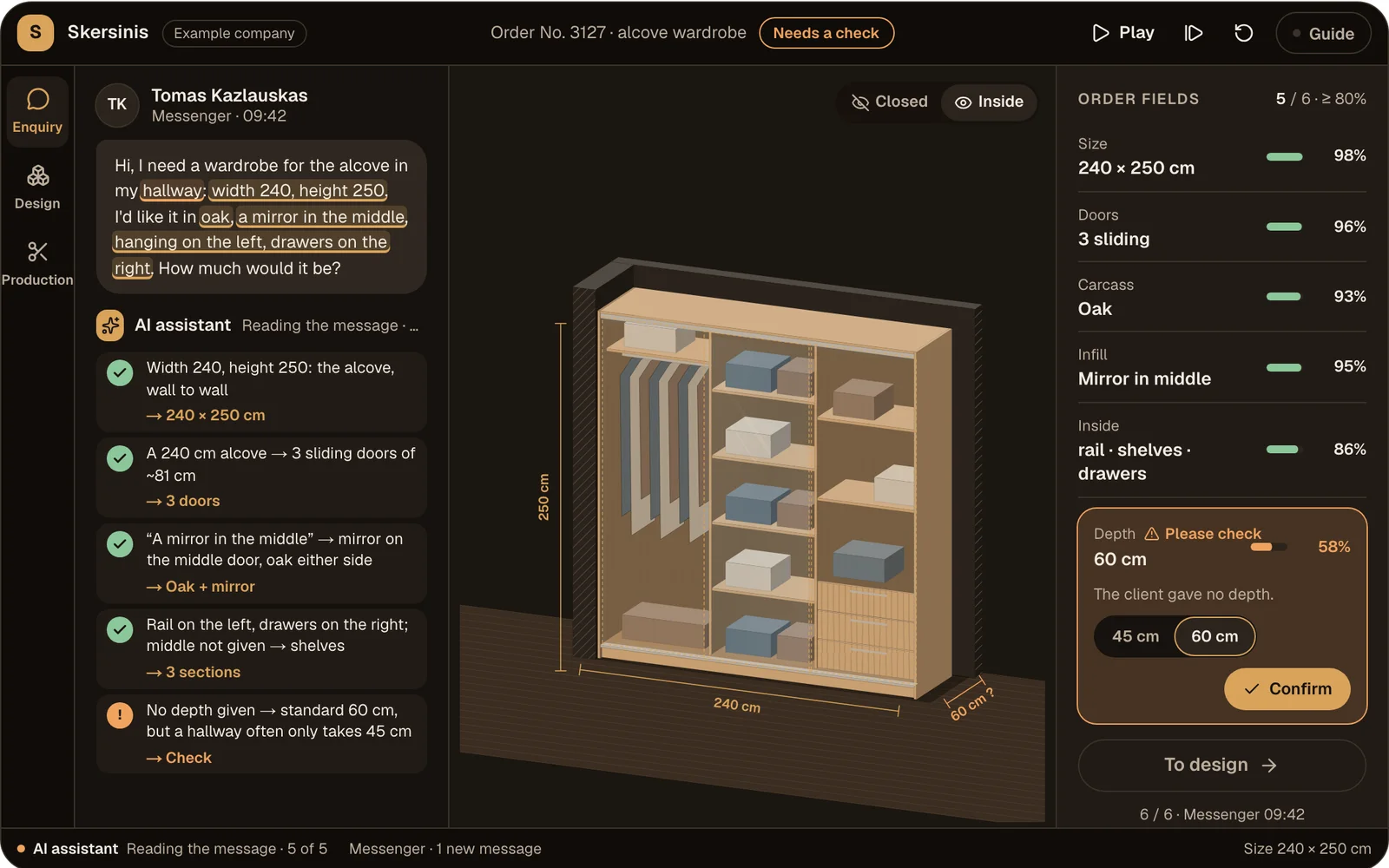
- 1Readsthe material: log scans, images of boards and lamellas, or the sizes of panels, sheets and offcuts.
- 2Gradesdefects such as knots, cracks, rot and wane with computer vision, by your grading rules.
- 3Optimisesthe cutting plan for the orders and your price list, so each piece of material gives the most value.
- 4Waitsfor the operator to accept or change the plan, then sends the cut list to the saw.A person decides
Price
- 1. Pilot€7,200
- One material and one line
- The optimiser run on your past orders and scans
- Report: yield and value against current practice
- Hardware specification, if camera grading is needed
- 2. Implementationfrom €32,000
- Up to 2 lines or materials
- Operator screen, and cut lists to the saw
- Orders, stock and offcuts from your ERP
- Defect grading by computer vision, where boards are scanned by camera
- Acceptance test on your material, and training
- 3. Licence and support€1,500 /month
- Software licence for one line, at the line or in the EU cloud
- Retraining of defect grading, and updates
- Remote monitoring, and 2 hours of support a month
- Monthly yield report
Fair use: One line is one saw or optimising station with its scanner or camera station, for any number of plans. Each extra line is €290 a month.
Works with your systems
- ScannersLog and board scanners that export shape and defect data as XML, CSV or through their API; your own camera station for boards and lamellas.
- Saws and CNCCut lists to panel saws, optimising cross-cut saws and CNC machines through their import formats (CSV, XML) or OPC UA.
- MES / ERPOrders and stock from Rivilė, B1, Business Central or Odoo, and the parts produced and yield back, through their APIs or import files.
- Part listsPart lists from your design software as CSV or XLSX.
- PLCOPC UA or Modbus TCP, where the saw takes its settings from the PLC.
- CSV / APIExports and the REST API for any other system.
Data security and GDPR
- In the EU, or at your plantThe system runs in our cloud on EU servers, or entirely on a computer at your plant. With the on-premises option, images and machine data stay in the plant; only service metrics leave it.
- Your data trains only your modelModels are adapted on your data and used only on your lines. Your images and measurements are not used for other clients' models and are not passed on.
- Traceable for a yearScans, images and plans are kept for 12 months, so a part can be traced back to its log or sheet; you can set another period.
- Your prices stay yoursThe price list and grading rules are used only to value your cutting plans, and are visible only to the roles you choose.
- Access by roleOperators, production technologists and administrators each see and confirm what their role allows, and every change to a plan goes into the activity log.
- GDPR in writingThe system works mostly with product and machine data. Personal data, such as user accounts and who confirmed what, is covered by a data processing agreement that lists every sub-processor.
What you provide
- Your orders or cutting lists, and the stock of material and offcuts, from the ERP or as files.
- Your price list by product and grade, and your grading and cutting rules.
- Data from your scanner or saw, or permission for your integrator to export it.
- Past production data to measure the current yield against.
- An operator or production technologist who knows the cutting rules, for the questions it raises.
- Purpose
- Optimises how raw material (logs, boards, lamellas, wood-based panels, metal sheet) is cut into parts for the orders and the price list, grades defects from images, and tracks yield and value.
- AI area
- Machine learning and computer vision (detection and grading of defects in images), and mathematical optimisation of cutting patterns and nesting.
- Production process
- Preparation of materials and raw materials, and technological preparation: cutting plans and cut lists for production.
- Inputs
- Log scans (3D shape, and inner defects where an X-ray scanner is present); camera images of boards and lamellas; sizes of panels, sheets and offcuts; orders and part lists; the price list by product and grade; cutting rules (kerf, trims, grain direction, minimum lengths).
- Outputs
- A cutting pattern for each log, board or sheet with its yield and value; cut lists and labels for the saw; an offcut register; yield and value by shift, line and batch; the plan compared with current practice.
- Materials
- Logs (breakdown patterns and log rotation); boards and lamellas (defect cutting, grading, finger-joint lengths); wood-based panels (chipboard, MDF, plywood); metal sheet (rectangular blanks).
- Models and approach
- Convolutional neural networks detect and classify defects in board images, adapted on your graded samples; value models come from your price list and grades; the cutting plan is optimised by integer programming and guillotine and strip-packing heuristics, with your cutting rules as constraints. The same input always gives the same plan.
- Accuracy validation
- Defect grading: recall and precision for each defect class on a held-out set of your graded images. Optimisation: yield (good volume or area out, against material in) and value per m³ or m², compared on the same material between the plan and current practice, in the pilot and the trial run.
- Hardware
- None where the input comes from an existing scanner or the ERP; for camera grading, a camera station with lighting and an industrial computer with a GPU.
- Integrations
- Log and board scanners (XML, CSV, API); panel saws, cross-cut saws and CNC through their import formats or OPC UA; Modbus TCP; MES or ERP (Rivilė, B1, Business Central, Odoo) through APIs or import files; CSV, XLSX and the REST API.
- Hosting
- Two options: our cloud on servers in the EU, or on-premises on an industrial computer at your line, with nothing leaving the plant but service metrics. Daily backups kept for 30 days; TLS in transit, encryption at rest.
- Languages
- Interface in Lithuanian and English.
- Limits
- Rectangular parts: free-form contours are not part of the standard product. Up to 5,000 parts and 500 sheets or panels per plan.
- Access
- Sign-in with Microsoft Entra ID or Google, or local accounts for shared screens on the shop floor. Roles: operator, lead (quality, maintenance or production), administrator. Activity log of every confirmation and change.
- Human oversight
- The operator accepts or changes each plan; changes are logged and measured against the plan.
- Support
- Business days 8:00–17:00 Vilnius time, remote; critical faults answered within 4 business hours; availability target 99.5% a month for the cloud part.
- Delivered as
- A standard product under licence, configured for your line, with its models adapted to your data. It is not software or an AI model developed to your order.
EU funding · call 02-126-K
The EU can pay half of an AI project for your factory
We prepare the technical part of the application: the case for AI, the specification and the commercial offer. Whether the project is funded is decided by the funding body.
Example: camera quality inspection
An AI project for a factory€38,900pilot, build and hardware
EU funding, 50%€19,450
You pay€19,450
Apply by 8 December16 days left
Frequently asked questions
Didn't find the answer? Ask the AI assistant at the bottom right.

Will it work with our scanner and machines?
On most lines, yes: the optimiser reads scanner data as XML, CSV or through an API, and sends cutting lists to the machines in their import format or over OPC UA.
How will we know the plan really is better?
In the pilot the optimiser's plans are compared with how the raw material was actually cut, and in the trial period the yield is measured both ways on the same raw material.
Does it work for free-form parts?
The standard product is for rectangular parts. Free-form contours are not included.
Can we really get 50% EU funding?
Call 02‑126‑K part-funds AI in the production processes of manufacturing SMEs. We prepare the technical part and the commercial offer; whether the project is funded is decided by the funding body.
Tell us what you need built
A 30-minute video call, then a proposal with a fixed price. Rather not call? Write a message
Book a call
A 30-minute video call. We work out the task and tell you the price range.
November