Every part checked at the line, and rejects stopped before they are packed.
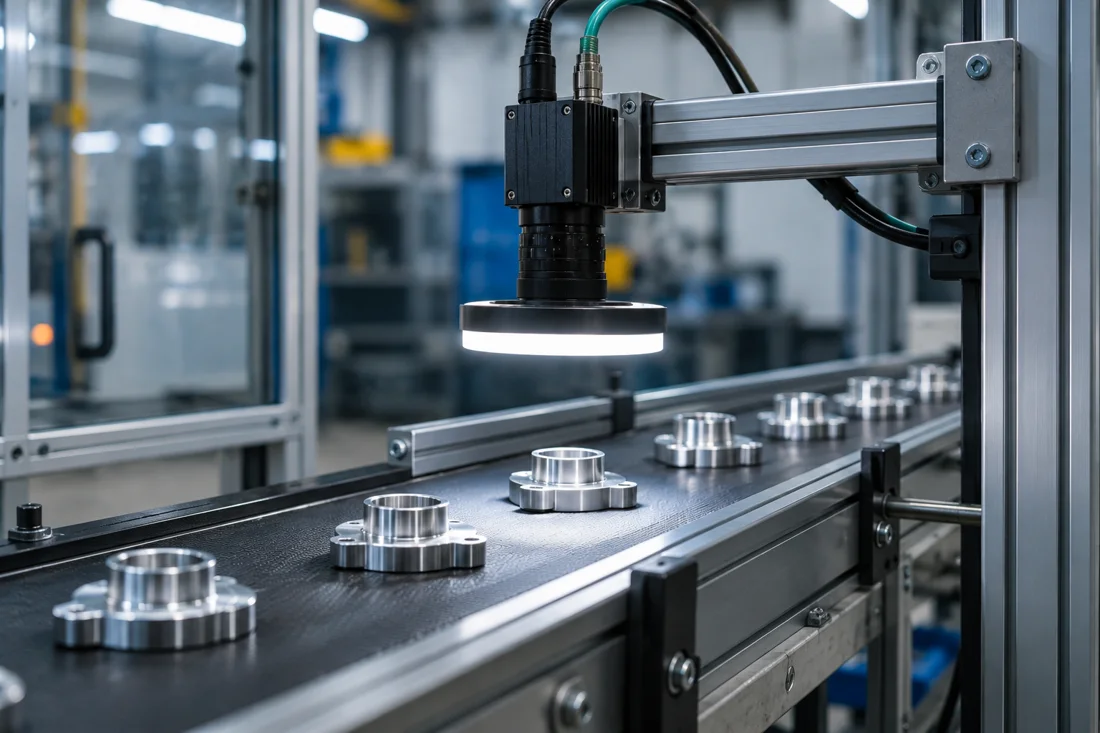
AI visual quality inspection puts an industrial camera over your line and checks every part or package as it passes: welds, seals, labels and print, fill level, surface and dimensions.
What changes
- Fewer defects reach the customerEvery part is checked, not a sample, so a defect is caught at the line instead of in a complaint.
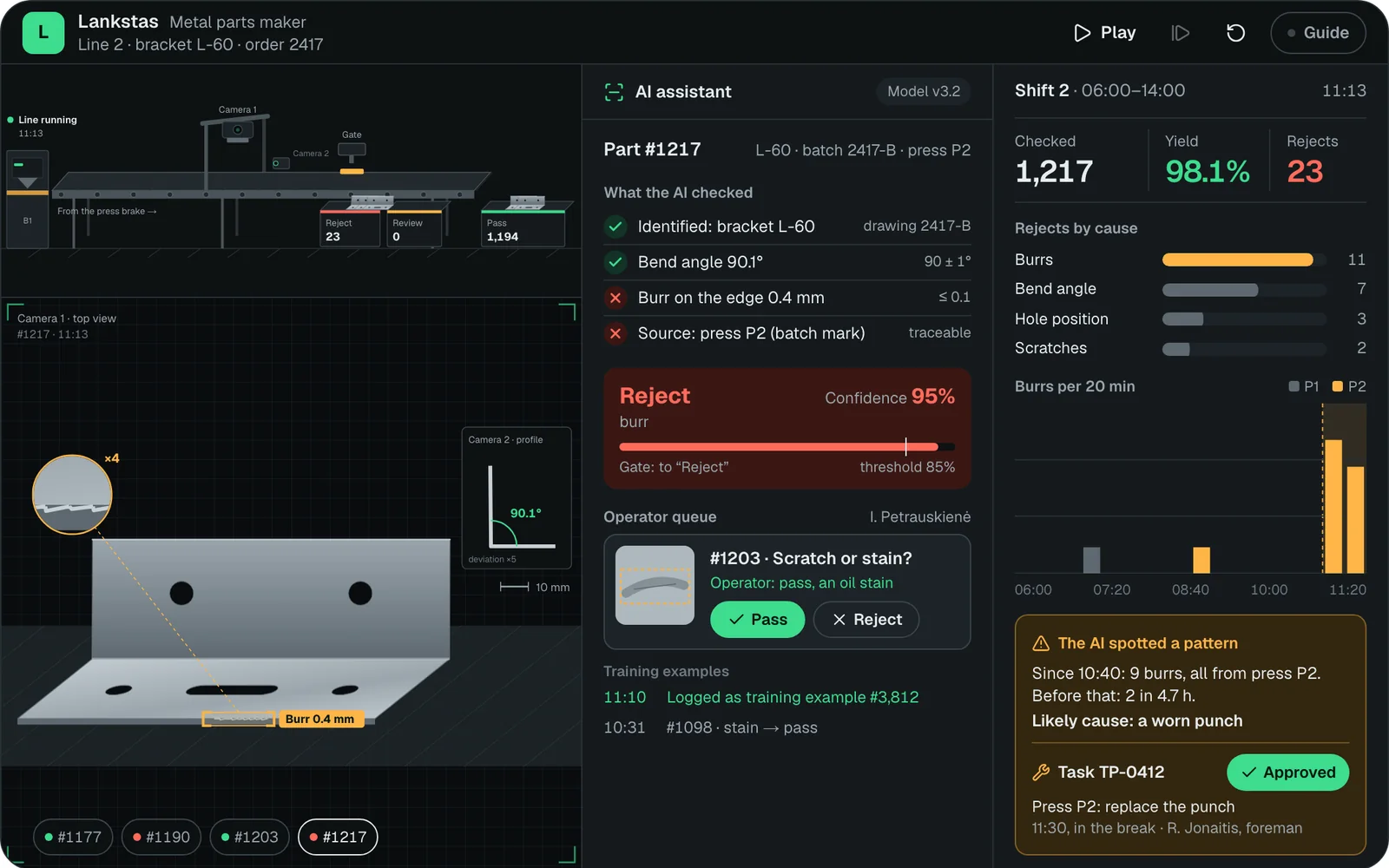
- You see where defects come fromDefect counts by class, line, shift and hour show which machine or batch starts producing them.
- It gets better on your partsOperator confirmations retrain the model, and a new version goes live only after it beats the current one on your test images.
How it works
- 1Capturesevery part or package with an industrial camera and fixed lighting, triggered by a sensor on the conveyor.
- 2Inspectsthe image for each defect class and measures what has a tolerance, with a confidence score for each finding.
- 3Rejectsclear defects through your PLC: a pusher, an air jet or a line stop.
- 4Handsdoubtful cases to the operator, and each decision goes into the next training set.A person decides
Price
- 1. Pilot€7,000
- One inspection station on one line, one product family
- Up to 5 defect classes trained on your parts
- Measured report: defects found, defects missed and good parts rejected
- Camera and lighting specification for the implementation
- 2. Implementationfrom €27,900
- Up to 2 inspection stations
- Up to 15 defect classes
- Reject signals through your PLC, the operator screen and alerts
- Results to MES or ERP, and the defect statistics
- Acceptance test on a held-out set of your images, and operator training
- 3. Licence and support€1,500 /month
- Software licence for one inspection station, at the line or in the EU cloud
- Retraining on operator-confirmed images, and tested model updates
- Remote monitoring, updates, and 2 hours of support a month
- Monthly quality report
Fair use: One inspection station is one point on the line with up to 2 cameras and one computer, for any number of parts. Each extra station is €290 a month.
Works with your systems
- PLCReject, stop and alarm signals through digital I/O, OPC UA, Modbus TCP, or PROFINET through a gateway.
- OPC UA / MQTTResults and counts published for your SCADA, MES or historian.
- MES / ERPDefect counts by batch or order to Rivilė, B1, Business Central or Odoo, through their APIs or import files; batch data for checking label print.
- CamerasIndustrial cameras with GigE Vision or USB3 Vision, area-scan or line-scan.
- AlertsMicrosoft Teams, email or SMS when a defect rate passes its limit.
- CSV / APIExports and the REST API for any other system.
Data security and GDPR
- In the EU, or at your plantThe system runs in our cloud on EU servers, or entirely on a computer at your plant. With the on-premises option, images and machine data stay in the plant; only service metrics leave it.
- Your data trains only your modelModels are adapted on your data and used only on your lines. Your images and measurements are not used for other clients' models and are not passed on.
- Cameras look at the productThe field of view is set to the product on the conveyor, so staff are not filmed. Images of rejects and doubtful parts are kept for 12 months for traceability, images of good parts for 7 days; you can set other periods.
- The line's safety stays as it isSignals reach the line only through your PLC, set up by your automation engineer. Emergency stops, guards and interlocks are never controlled by the AI.
- Access by roleOperators, quality leads and administrators each see and confirm what their role allows, and every confirmation goes into the activity log.
- GDPR in writingThe system works mostly with product and machine data. Personal data, such as user accounts and who confirmed what, is covered by a data processing agreement that lists every sub-processor.
What you provide
- Mounting of the camera and lighting by your maintenance team or integrator, following our installation sheet.
- An automation engineer who connects the reject signal in your PLC.
- Good parts and parts with each defect class, photographed at the line during the pilot.
- Your quality criteria: defect classes, tolerances and what counts as a reject.
- A network connection for the computer at the line, or approval to run it fully offline.
- The operators who will decide doubtful cases, for a short training session.
- Purpose
- Checks every part or package on a production line from camera images, rejects or flags defects through the line's PLC, and keeps defect statistics and the image history.
- AI area
- Computer vision: detection, classification and segmentation of defects in images, and optical measurement.
- Production process
- Production control: in-line quality inspection after a process step or before packing.
- Inputs
- Images from 1 to 4 industrial cameras per station (GigE Vision or USB3 Vision, area-scan or line-scan); a trigger from a sensor or the PLC; optionally the batch or order number from MES or ERP.
- Outputs
- Pass, reject or check-by-operator for each part, with the defect class, location, measurement and confidence; reject and alarm signals to the PLC; results over OPC UA, MQTT or the REST API; defect statistics and the image history; a monthly quality report.
- Defect types
- Welds (porosity, undercut, short or missing seam, spatter); seals (wrinkles, product in the seal, open seal); labels and print (missing, skewed, wrong or unreadable date and batch code); fill level and caps; surface (scratches, dents, cracks, stains, coating faults); dimensions and presence of features.
- Models and approach
- Convolutional neural networks for defect detection and segmentation, pretrained and then adapted on your images; anomaly detection trained on good parts only, for defects that are rare; optical character recognition for date and batch codes; rule-based measurement of edges, distances and levels. Each model version is stored with its training data and test results.
- Accuracy validation
- On a held-out set of your own labelled images that is never used for training: recall (the share of defects found) and precision for each defect class, the false reject rate (good parts rejected) and the escape rate (defects missed). Acceptance thresholds are agreed in writing in the pilot, checked again for every new model version and, in use, on a daily audit sample.
- Throughput
- 20 to 150 ms per image on the computer at the line, depending on resolution and model; up to about 10 parts a second per station.
- Hardware
- Per station: an industrial camera with a lens, LED lighting, a trigger sensor and an industrial computer with an NVIDIA GPU, specified for each line.
- Integrations
- PLC through digital I/O, OPC UA, Modbus TCP, or PROFINET through a gateway; MQTT; MES or ERP (Rivilė, B1, Business Central, Odoo) through APIs or import files; CSV and the REST API; alerts to Microsoft Teams, email or SMS.
- Hosting
- Two options: our cloud on servers in the EU, or on-premises on an industrial computer at your line, with nothing leaving the plant but service metrics. Daily backups kept for 30 days; TLS in transit, encryption at rest.
- Languages
- Interface in Lithuanian and English.
- Limits
- A defect must be visible in the image: the smallest reliable defect is about 4 pixels across, so the camera and lens are chosen in the pilot for the size you need. Up to 4 cameras and 30 defect classes per station. Transparent and mirror-like surfaces need special lighting, tested in the pilot.
- Access
- Sign-in with Microsoft Entra ID or Google, or local accounts for shared screens on the shop floor. Roles: operator, lead (quality, maintenance or production), administrator. Activity log of every confirmation and change.
- Human oversight
- Doubtful parts go to the operator; the thresholds for automatic rejection are set by your quality lead; a new model version needs approval before it goes live.
- Support
- Business days 8:00–17:00 Vilnius time, remote; critical faults answered within 4 business hours; availability target 99.5% a month for the cloud part.
- Delivered as
- A standard product under licence, configured for your line, with its models adapted to your data. It is not software or an AI model developed to your order.
EU funding · call 02-126-K
The EU can pay half of an AI project for your factory
We prepare the technical part of the application: the case for AI, the specification and the commercial offer. Whether the project is funded is decided by the funding body.
Example: camera quality inspection
An AI project for a factory€38,900pilot, build and hardware
EU funding, 50%€19,450
You pay€19,450
Apply by 8 December16 days left
Frequently asked questions
Didn't find the answer? Ask the AI assistant at the bottom right.
Will it work for our products?
In the pilot we train up to 5 defect classes on your parts, and the report shows the defects found and missed and the good parts wrongly rejected. If the accuracy is not good enough, we don't start the build.
What does the operator do?
Decides the doubtful cases with “pass” or “reject”. Those decisions become training data, and your quality manager sets the automatic reject limits.
Do we have to change the line?
No. The camera and lighting are mounted to our instructions, and the reject signal goes into your existing PLC through digital inputs and outputs, OPC UA, Modbus TCP, or PROFINET through a gateway. The line's safety does not change.
What does the hardware cost?
The camera, lens, lighting, sensor and computer are chosen for each line; you get the specification after the pilot. Under 02-126-K such hardware can be eligible if it is no more than 50% of the AI product's costs.
Does it work without the internet?
Yes. Inspection runs on the computer at the line; a connection is needed only for remote monitoring and updates, or the system can run fully offline.
Tell us what you need built
A 30-minute video call, then a proposal with a fixed price. Rather not call? Write a message
Book a call
A 30-minute video call. We work out the task and tell you the price range.
November