Waste collection schedule software: the address is the hard part
How our waste collection schedule software turns operators' route text into one schedule per house, and how staff record holiday changes.
AFKzona Group · 6 min read
- The short answer
- Collection schedules are published as prose, and the prose has a grammar
- The registry building, not the text, decides the schedule
- Every building either has a route or appears on a list
- The website and the reminder email must read the same answer
- Evaluating waste collection schedule software: five questions to ask
- What generalises
- Questions
The short answer
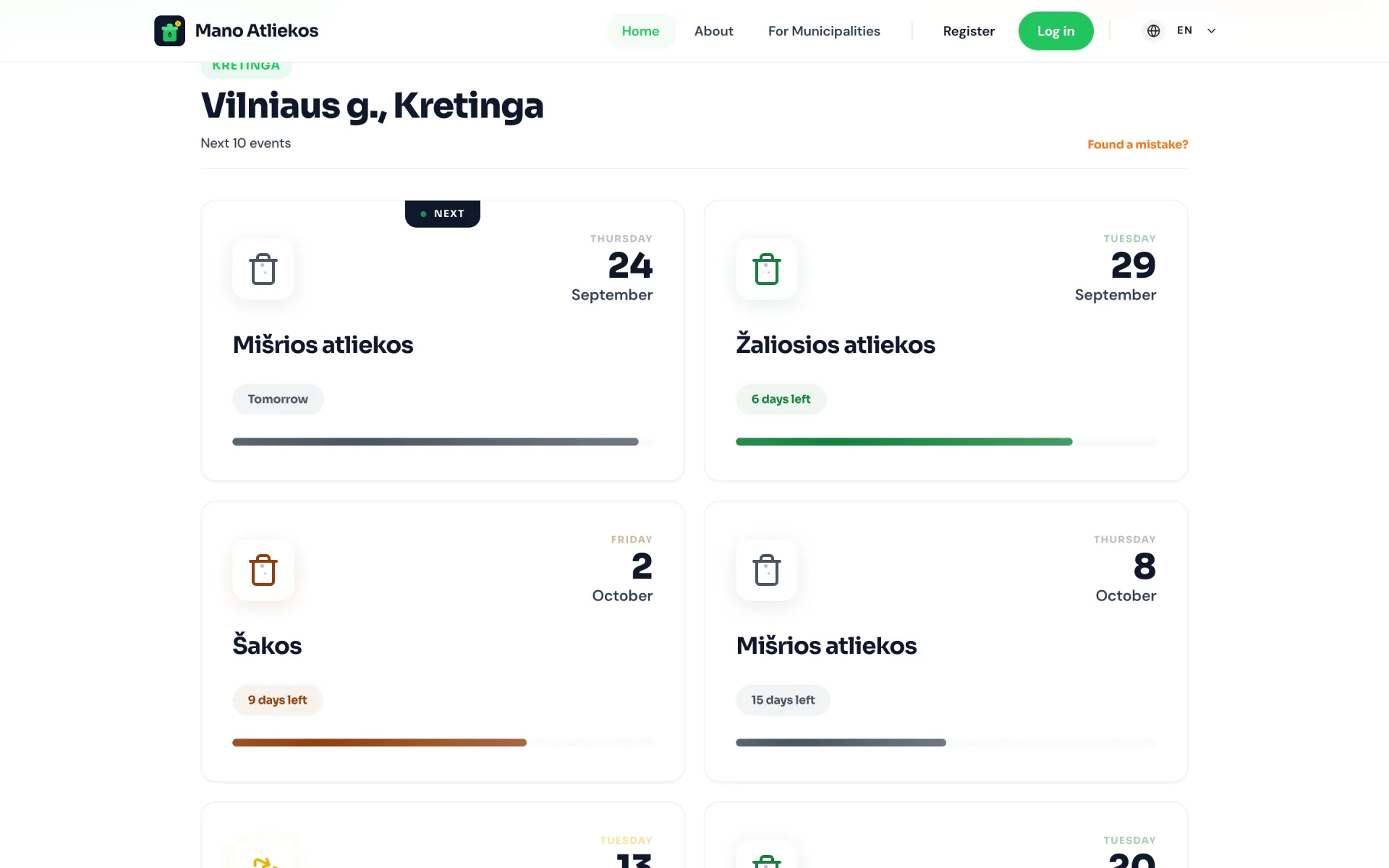
- Mano Atliekos is waste collection schedule software for Lithuania: residents find their address and see when each waste type is collected, and municipalities and waste operators run schedules, changes and announcements from a back office.
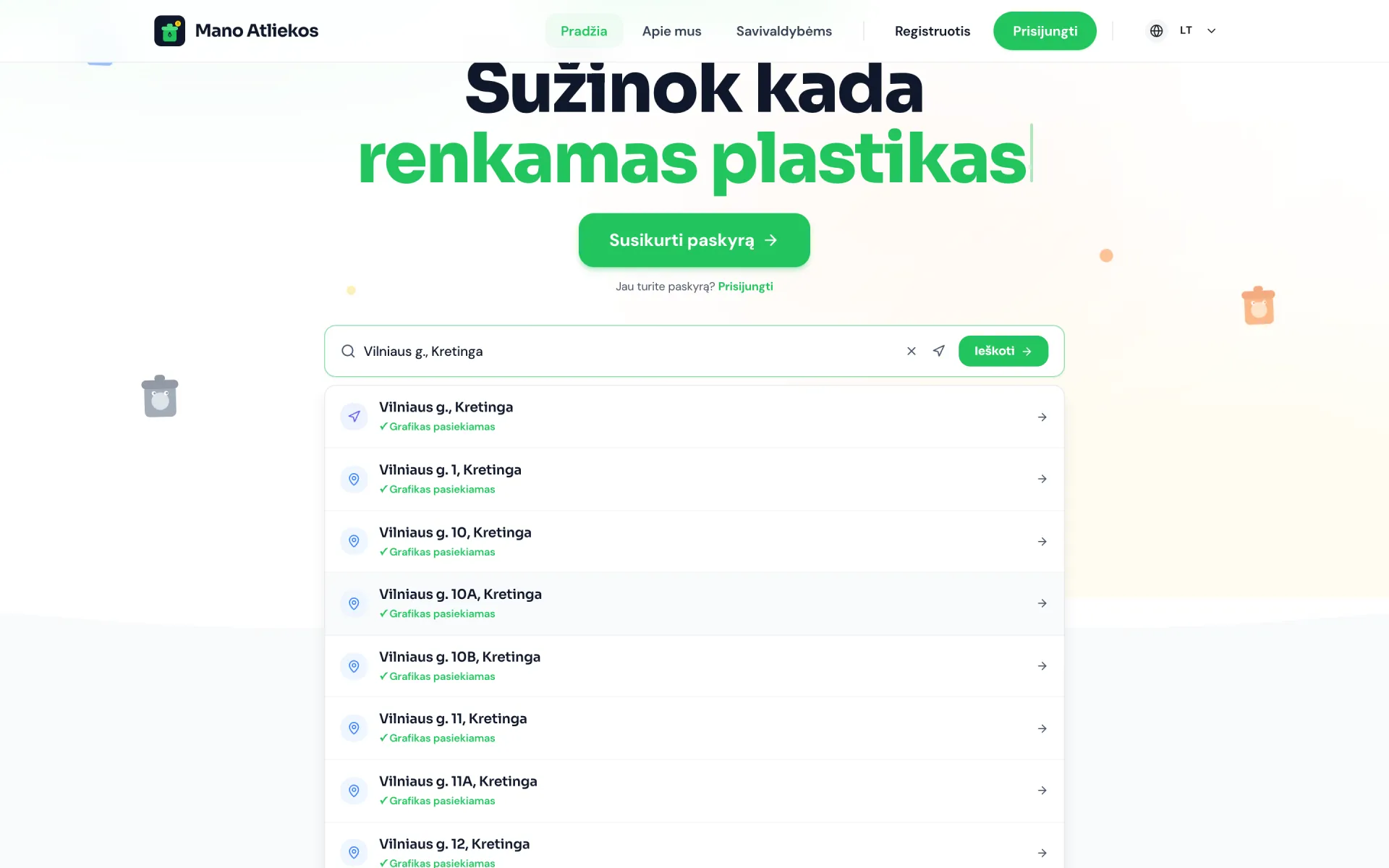
- Addresses are resolved to buildings in the national address register, and each building's route is the authoritative answer. The search lists register buildings with their settlements, and the resident picks their own.
- For each waste type, every registry building has a route or sits on an exportable list of addresses the operator's routes leave out, which staff send back to the operator.
- The website and the reminder emails read the same building-to-route binding, so the page and the inbox name the same route for each waste type.
A waste operator's collection schedule does not list addresses. It lists routes, and under each route a line of text written for a person to read: "Taikos g. (tik iki 101)", "Vilniaus g. (nuo 31 iki 79)", a village "(be Beržų, Liepų g.)". A resident types "taikos 17a". Between the two, something has to decide which Tuesday is theirs.
Mano Atliekos, our system live at manoatliekos.lt, makes that decision for seven waste types, on the website and in email reminders. It has 76 pages and 57 data models. This case study follows one house from route text to its schedule.
Collection schedules are published as prose, and the prose has a grammar
Operators publish schedules as PDF, Excel or Word files made for reading, not lookup. Each entry is a route, a list of dates and a paragraph of locations. The locations follow their own grammar: whole settlements, streets with house ranges, "only these streets", "all except these streets", garden communities and apartment blocks.
"(tik iki 101)" and "(tik nuo 102)" split one street between two routes. "(be …)" and "(tik …)" apply to whole villages. Ranges appear inline ("1–19") or in brackets ("Nr. 17 – 29"). Garden communities (sodų bendrijos, "SB …") have internal streets the national register often lacks.
Residents type "Vilniaus g.12" or "zemaiciu 4", with the letter glued on ("17A") or spaced ("119 k").
The registry building, not the text, decides the schedule
We import the national address register from Registrų centras: municipalities, wards, localities, streets and buildings, each building with its house number, korpusas and coordinates. The resident's address is resolved to one of those buildings, and that building's route for each waste type is the authoritative answer.
Normalisation strips diacritics, street-type words (g., pl., pr., skg., al.) and Lithuanian case endings, so "Žemaičių" and "zemaiciu" meet. Settlement names are matched exactly, so villages with similar names stay apart.
The search offers buildings from the register, each with its settlement, so a resident picks their own house. Letters matter: 12.3% of buildings in the imported register carry one, so "17A" is matched exactly as typed. Each house number is checked against every route's range, so a house on a split street gets the schedule for its own part of the street.
Garden communities are matched by geometry: registry coordinates in the LKS-94 grid are tested against the community's polygon, and the polygon decides the route.
The resident picks their own building from the register, so the date on the screen is the date for their house.
Every building either has a route or appears on a list
For each municipality and waste type, the system precomputes a building index: every registry building, the route it belongs to, or nothing. Buildings with nothing appear on an unmapped-addresses list with full address, korpusas and coordinates, which staff export and send to the operator. A gap in coverage becomes a row, not a complaint.
Staff rebuild the index from the back office after routing changes, and registry imports rebuild it too; each waste type is replaced in a single transaction, so residents always read a complete index. An Excel export lists every building with its route beside every source rule.
Staff cancel or move collections from a calendar. A reason is required, and the audit log records who made the change, why, which collections it affected and, for a move, the new date. The system drafts a notice listing the affected streets and waste types, which staff send to the residents of those streets by email and in the resident portal. For a reported missed collection, staff can check whether it was planned that day.
Operators publish dates, not rules, so the source of truth is an explicit list of dates per route. Weekly, fortnightly and monthly rules generate those dates, and a holiday move is entered once in the calendar, with its reason.
The website and the reminder email must read the same answer
Reminder emails and the website take their routes from the same building index, not from the resident's street name. A route is filed under its lead street and serves many more, so the lookup by building finds every packaging and glass route that serves the house. With one index behind both, the page and the email name the same route for every waste type.
Food waste follows the same rule: one shared check decides whether a food container is registered for the building, and both channels call it.
Residents choose the send hour and lead time (for example 08:00, 24 hours ahead, Lithuanian time), and each collection is reminded exactly once. The website is in Lithuanian and English; reminders go out in seven languages, adding Latvian, Estonian, Polish, Russian and Ukrainian.
Evaluating waste collection schedule software: five questions to ask
| Question | What good looks like |
|---|---|
| Is an address matched to a registry building, or only to text? | A register building with its house number and letter |
| What happens when an address fits two streets or settlements? | The resident sees the options and chooses |
| Can you list every address that has no route? | An exportable list per waste type, sent to the operator |
| How is a holiday move recorded? | Entered once with a reason, audit-logged, with a drafted notice listing the affected streets |
| Do the website and the reminders use the same lookup? | One binding per building and waste type, read by both |
What generalises
The pattern is not about waste. Wherever rules are written as prose for people (tariff zones, school catchments, delivery areas) and customers identify themselves by address, the work is the same: resolve the customer to an entity in an authoritative register, bind each entity to exactly one rule, and turn entities with no rule into a list someone owns.
The second lesson: when two channels must give the same answer, give them one resolver, and they agree by construction.
If you run waste collection for a municipality and want to walk through the back office, book a call; our public sector work and the product screens show more.
Common questions
How does waste collection schedule software find my address?
In Mano Atliekos, the typed address is normalised (diacritics, street-type words and Lithuanian case endings removed) and matched to a building in the national address register by street, settlement and house number, letter included. The system then looks up which route serves that building for each waste type. The search shows each building with its settlement, so the resident picks their own house.
What happens to waste collection on public holidays?
In Mano Atliekos, staff move or cancel the affected collections in the back office calendar in one step, with a written reason. The change is recorded in the audit log, the resident's schedule shows the new date, and the system drafts a notice listing the affected streets and waste types, which staff send to the residents of those streets by email and in the resident portal.
Can I get a reminder before bin collection day?
Yes. A resident can switch on email reminders for a saved address, choose how far ahead and at what hour (for example 24 hours ahead at 08:00, Lithuanian time), pick which waste types to be reminded about and add extra recipients. Each collection is reminded exactly once. Reminder emails go out in seven languages.
Why does a letter in my house number matter for the waste schedule?
Because one street can be split between routes at a given house number, and 17 and 17A can be different buildings in the address register. About one building in eight in the imported register carries a letter suffix. Mano Atliekos therefore matches the number exactly as typed, letter included, so every resident selects their own building.
What should a municipality look for in waste collection schedule software?
Ask whether addresses are matched to registry buildings or only to text, what happens when an address fits two streets, whether you can list every address with no route, how a holiday move is recorded and who is told, and whether the website and the reminders use the same lookup. Those points decide whether residents get the right date, more than the interface does.